


A Cemetery Became More Valuable as a Mall: Rematriation and What Property Law Refuses to Count
This blog post is a guest entry by Katie Wilberding, a 2L law student enrolled in “Liberation Lawyering,” a course taught by SELC staff attorney Veryl Pow at Northeastern University School of Law this fall. Katie wrote this introspective post as a way to integrate the unit on decolonization and rematriation in the course. The unit featured a deep dive into the work of our client, the Sogorea Te’ Land Trust (and Corrina Gould, one of its cofounders). Katie weaves in her own analysis on women’s bodies and motherhood with the broader work of land rematriation. In the end, this post reminds us that rematriating land against settled notions of property is work to dismantle patriarchy.

Photo taken by the author of Lincoln Park in Chicago. The author invites us to imagine what a rematriated Chicago, as inspired by the Chi-Nations Youth Council to actualize a First Nations Garden, could look like.
Read moreLiberating Roots with Rootbound Film Project
This blog post is a guest entry from Rootbound Film Project, a fiscally sponsored project of Sustainable Economies Law Center.
Right now, reading our 95-page screenplay, I see the animate force of our film’s story emerging, bristling with roots straining against concrete and capitalist malaise; stretching through the Sonoma and Mendo woods to the wild sovereign spaces with older names, beyond all maps; and reaching back to our Bay Area’s urban beauty blooming. Characters have taken on shape, blood and bone, incarnated from ancestral trauma which is our own, with ancient futurist energies forging previously unimagined worlds.
Read moreReflection on New Economy Coalition's Assembly for Our Future
Late July in North Carolina most years swelters, a muggy, peak heat experience, with the occasional warm summer rainshower. But the 160+ organizers, co-op owners, teachers, artists, facilitators, and more who converged on Durham for the New Economy Coalition People’s Assembly arrived in a cool, gray city at the peak of a historic drought. The Eno River trickled along at the lowest levels in recent memory. Nothing was as it should be... and yet we persisted.
It’s been seven years since the Coalition gathered in person in Virginia. In that span of time we’ve lived through a pandemic, a cascade of apocalypses, and a steady march towards authoritarianism. Perhaps because of this pressure, the magic of being in-person was especially powerful; as was the difficulty for people to venture outside their homes, commit to being in the flesh for three days, and trust they will be safe in increasingly dangerous times.
IMAGE ID: A group of Assembly attendees stand facing a stage. They all have one hand stretched out in front of them with their palms facing forward. Photo by Nica Guerrero.

Cooperatives as Incubators of Democracy
We Lived Happily During the War
by Ilya Kaminsky
And when they bombed other people’s houses, we
protested
but not enough, we opposed them but not
enough. I was
in my bed, around my bed America
was falling: invisible house by invisible house by invisible house.
I took a chair outside and watched the sun.
In the sixth month
of a disastrous reign in the house of money
in the street of money in the city of money in the country of money,
our great country of money, we (forgive us)
lived happily during the war.
Read morePodcast: Redneck Gone Green with Hasmik Geghamyan
(Hosted by Democracy At Work)

Staff Attorney Hasmik Geghamyan shares in this podcast:
"We've all grown up in places where sharing resources and ways of life was in solidarity with each other. We have to resurface what it is and what it means in these times. Instead of trying to define it, she said she would ask the person these three questions:
Who owns the things we depend on?
Who makes the decisions?
Who benefits from those decisions?"
Public Lands for Agriculture: Food Sovereignty for Future Generations
Imagine a California with thousands of acres of publicly owned farms. In this world, our public institutions would ensure access to affordable agricultural land to farmers who practice sustainable ways of farming. With these resources, farmers would grow and provision an abundance of nutritious food and deliver them to their own communities. Instead of being expected to spend the bulk of the daylight hours working to produce food, farmers would enjoy a standard of living like any other worker outside of agriculture.
Glimmers of this world are emerging. For example, just 35 miles away from our office in Downtown Oakland is an 18 acre farm called Sunol AgPark. Owned by the San Francisco Public Utilities Commission (SFPUC) and managed through a partnership with the Alameda County Resource Conservation District (ACRCD), Sunol AgPark is home to six small scale-organic farmers. What would this look like at a much larger scale?
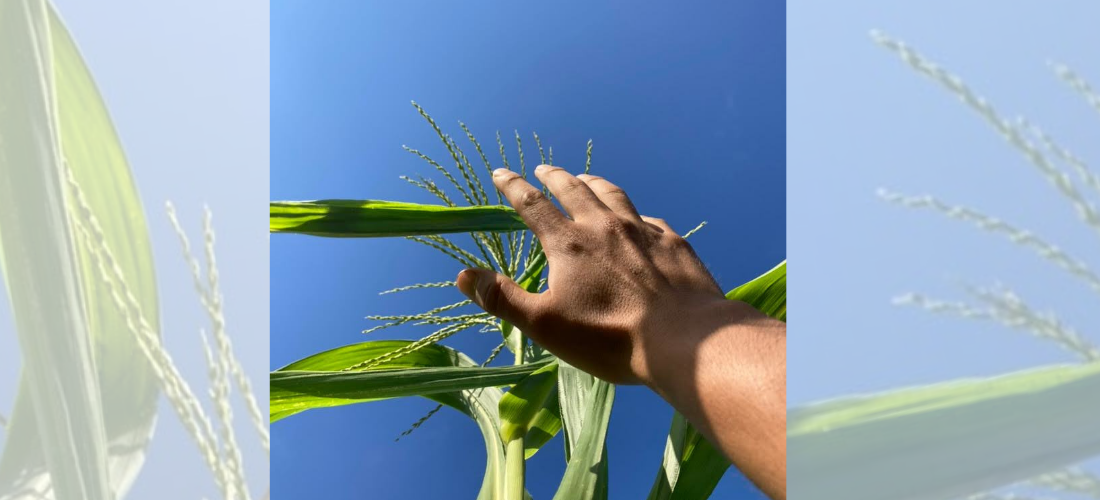
PHOTO ID: A corn stalk set against a stark blue sky. A hand reaches towards the corn stops.
When I was a full-time farm manager, I had dreams to one day co-own a cooperative farming enterprise. Leasing publicly owned land at an affordable rate would have been a great way to make such a business viable. Now, I want to help make that world a reality for others. In my role as Director of Holistic Land Relations at the Sustainable Economies Law Center, I get to focus on building land and food systems infrastructure with my coworkers.
Read moreAll Hands on Deck: Recap and Resources
Thank you to everyone who joined us last month for #AllHandsonDeck campaign! We appreciate everyone who helped us raise $41,181! Alongside our fundraising — which also raised $4,118 for our solidarity partners Huitlaco Mushrooms — we offered a three part series of facilitation tools and skills, debuted a new toolkit on how to reshape policy, and held space to share short stories, insights, practices, and contemplations to break up the heaviness of our times.

IMAGE ID: A diversity of Law Center staff are arranged in a collage with the words laid over a ombre purple background. The words, "Thank you!" is above their heads.
Read moreProposal to Ban Land Grabs Moves Forward at February 3, 2026 Richmond City Council Meeting

IMAGE ID: Law Center staff attorney's Tobias Damm-Luhr, Hasmik Geghamyan, and Mohini Mookim sit in front of Richmond City Council giving a presentation on their legal research into how to ban land grabs.
On February 3, 2026, Richmond City Council invited the Law Center to present updates on the proposal to ban corporate land grabs in Richmond.
Read moreOur Favorite Reads of 2025
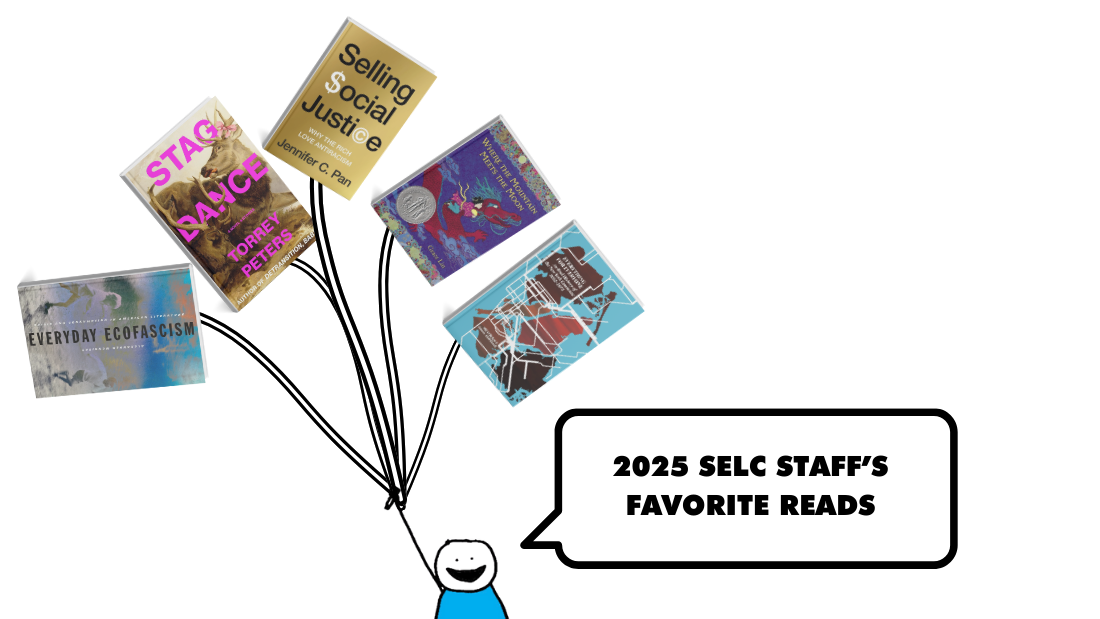
A favorite grounding practice at the Law Center is reading! Below is a list of a few of our favorite books from last year. These writings inspired us, made us cry, sparked our imaginations, and so much more!
Our Favorite Fiction Books:
The Deluge, by Stephen Markley (Recommended by Nicole)
I finished this 900 page tome while lying in a camper van in a gorgeous, secluded spot in the Canadian Rockies, surrounded by receding glaciers. My 6 month old daughter was napping on the bed next to me, and upon closing the book I proceeded to bawl my eyes out in a body-wracking 30-minute cry. This powerful, expansive, nuanced and insightful read into the climate movement starts in the near past, covering recent historic events, and extends into the following few decades. The book, published in January 2023, was wildly prescient, predicting major climate and political events of the last two years that would have been truly unthinkable previously (not giving any spoilers here, but I’m not talking about the return of the Trump administration, which many movement organizers foresaw). A multi-character epic showing the long journey of political formation of its characters and exploring the many roles to be played in response to the climate crisis - from denial to resistance, cooptation to sabotage - this book manages to be hopeful and devastating at the same time. A true punch in the gut, but one I could not recommend more.
Everything for Everyone: An Oral History of the New York Commune, 2052–2072 by M.E. O’Brien and Eman Abdelhadi (Recommended by Mohini)
I finished this book almost a year ago, and I haven’t stopped thinking about it since. I am captivated by the political vision laid out in this work of speculative fiction, telling the story of a global uprising that begins with the liberation of Palestine. Communes—neighborhood communities that ensure that everybody’s needs are getting met—reconstitute New York City, and the book is told through a series of twelve interviews set in New York between the now-elderly authors and individuals who played a role in the uprisings. People have loads of trauma to work through by the 2050s, so the story goes, but post-capitalist forms of locally-rooted but regionally-coordinated governance are slowly healing people and planet. Democracy is participatory, and ecosystems are being healed by restoring Indigenous lifeways. Most of the planet is free from nation-states, property, and even money. I first read this book in a reading group facilitated by our friends at Movement Generation, and I found it so compelling that I led a reading group for it at the Law Center, which initiated a yearlong learning series on the theme, ‘Beyond the Nation State.’
Read moreAn Oakland nonprofit just bought a ‘pizza slice’ of land in SF. Here’s why
By Jillian D’Onfro from The San Francisco Standard
Excerpt:
“We’re moving past top-down charity models where people take the crumbs that rich people will give them and instead are self-determining their own solutions and creating ecosystems where you can be fed by the community and give food to the community,” said Mohini Mookim, a lawyer with the Sustainable Economies Law Center, or SELC, which works with Poor.
Read moreDecember 2025 Newsletter
As we wind down another year, it’s only natural to pause and reflect. This was yet another wildly unprecedented year that brought immense challenges for us all. So, how are we feeling about what we need to stay energized in 2026? Here at the Law Center, we spend a lot of time and resources maintaining our internal resilience. Internal resilience is a measure of our organizational capacity to take care of ourselves and our needs as workers, while building a just economy that will hopefully one day render our current capitalist system obsolete. When the resilience is high, it’s a strong, steady heart beat propelling our work forward.
Read moreWhat is Mutual Aid?
By THALIA BEATY from AP News
Excerpt:
Often, mutual aid groups collect money and distribute it to people who need it or use it to buy things. Groups should consider how to handle those funds as sometimes they can be flagged as income by a payment processor. The Sustainable Economies Law Center has a guide that lays out multiple scenarios that mutual aid groups might encounter. Mohini Mookim, an attorney with the center, said rules around giving money with no strings attached are generally promising for mutual aid groups.
Read more
October 2025 Newsletter
It has frequently been observed that terror can rule absolutely only over men who are isolated against each other… isolated men are powerless by definition.” — philosopher Hannah Arendt
Read moreHow to Develop a Community Housing Vision for Puerto Rico
By Alison Chopel et al. from Nonprofit Quarterly
Excerpt:
The PREC model was developed via a collaboration between the People of Color Sustainable Housing Network and the Sustainable Economies Law Center with the intention to develop a way to acquire real estate that could be owned by the community; enable residents to stay in a region undergoing gentrification; create permanency, especially for activists and artists; and be financed by community members and accredited investors together with philanthropists. The result was a new organizational structure that aimed to remove real estate from the speculative market while fostering community stewardship and equity.