Imagine a California with thousands of acres of publicly owned farms. In this world, our public institutions would ensure access to affordable agricultural land to farmers who practice sustainable ways of farming. With these resources, farmers would grow and provision an abundance of nutritious food and deliver them to their own communities. Instead of being expected to spend the bulk of the daylight hours working to produce food, farmers would enjoy a standard of living like any other worker outside of agriculture.
Glimmers of this world are emerging. For example, just 35 miles away from our office in Downtown Oakland is an 18 acre farm called Sunol AgPark. Owned by the San Francisco Public Utilities Commission (SFPUC) and managed through a partnership with the Alameda County Resource Conservation District (ACRCD), Sunol AgPark is home to six small scale-organic farmers. What would this look like at a much larger scale?
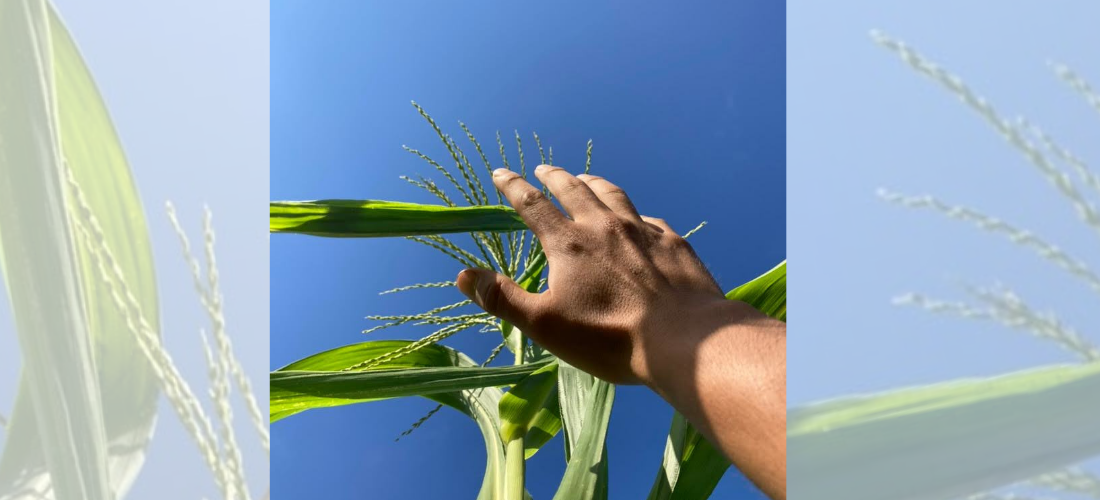
PHOTO ID: A corn stalk set against a stark blue sky. A hand reaches towards the corn stops.
When I was a full-time farm manager, I had dreams to one day co-own a cooperative farming enterprise. Leasing publicly owned land at an affordable rate would have been a great way to make such a business viable. Now, I want to help make that world a reality for others. In my role as Director of Holistic Land Relations at the Sustainable Economies Law Center, I get to focus on building land and food systems infrastructure with my coworkers.
The Problem: Land as a Commodity
Headquartered in the Bay Area, the Law Center has come to understand that the very nature of the housing market is to maximize rent and profit, not to provide shelter. This is a problem because everyone needs and deserves a home but very few people have the money to buy one! We believe a home is not something anyone should get to make loads of money from buying or selling. Like air and water, everyone needs them just to live, so we shouldn't treat them like something scarce and luxurious that we get to make money from.
The problem is that some people figured out how to make loads of money through buying and selling houses. It follows then that if you want to get to the root of housing as a commodity, you have to make it unprofitable. In other words, you have to decommodify it. How can we make it so that a house won’t make a landlord loads of money? We’re working with special legal tools to do just that!
At the Law Center, with the help of our partners and supporters, we have made a lot of progress in our vision to decommodify housing. We have helped pass the Moms 4 Housing legislation, introduced policy recommendations through our Ban Land Grabs campaign, helped pass a bill to research social housing, worked with organizations like Homefulness to center a poor people-led solution to homelessness, and incubated the East Bay Permanent Real Estate Cooperative to promote collective ownership.
What if we took that energy and applied it to farm land in California? Wouldn’t it be nice if we decommodified agricultural land too?
To Keep Food Affordable, We Need to Decommodify Agricultural Land
The Agricultural Land Equity Task Force was convened to address the unaffordability of farm land. I was appointed to join the Task Force with a consortium of 13 other advocates with diverse expertise, background, and place-based concerns. After two years, 13 meetings and more than 30 subcommittee meetings, we published a set of policy recommendations.
One solution we support is the Buy-Protect-Sell approach that has been popularized by the American Farmland Trust. In this scenario, a conservation organization buys land, protects it with easements, and then sells to farmers at a slightly more affordable price. This has been a great intervention, especially as half of all farmland is set to change hands in the coming years, and many farmers are having to sell their land to be able to retire. But like other ownership-based interventions, Buy-Protect-Sell leaves land vulnerable to market pressures and out of reach for future generations.

PHOTO ID: A hand cradles a nearly ripe heirloom tomato as it grows on a vine with greener tomatoes in the background.
What if we went even further and bolstered the land trust movement by lobbying the state to acquire farm land and hold it in public trust? This is what section 4 of the Agricultural Land Equity Task Force’s recommendations proposes. In this section, the Task Force recognizes (admittedly through a lot of my pushing) that California’s agricultural farmland is worth preserving for many generations. The recommendation writes:
“In addition to utilizing existing publicly held land, increasing public landholdings can halt the crisis of affordability at the root by removing agricultural land from the speculative land market, thereby intervening in the appreciation of land values over time. While expending public resources through grants or down payment assistance can help people acquire land, it does not effectively address the unattainable cost of land or the dependence on selling the land to the highest bidder to comfortably retire. Increasing the amount of publicly held land is one approach to slowing down the cycle of private gain while simultaneously increasing accessibility for priority producers and Tribal land stewards.”
Check out our policy recommendations here!
Public Lands for Agriculture Can Look Many Ways: We Want Them to Look Cooperative
When I was a legal apprentice, I spent a good amount of time researching “social housing.” I learned that social housing is a catch-all term for public housing, with a more favorable connotation than “the projects.” Holding land and housing in the public trust can look many different ways, with the capacity to be culturally resonant. For example, in places like Vienna and Singapore, people of all classes live in social housing. It isn’t relegated to the least fortunate, but rather, embraced as a central function of a society. Wouldn’t it be great if publicly owned farm land was also embraced as a central function of society?
To me, what’s exciting about holding farm land in public trust is the opportunity to change the relationship between those who grow food and the rest of the community. Currently, growers have a tenant/landlord or employee/employer relationship with farm owners, but do not have a relationship with the communities that they feed. Public lands can create the radically democratic forums we long for where we can practice community governance, feed our communities, and preserve the land for future generations.
I want to emphasize the word “can” in the sentence above. To be clear, holding land in public trust does not automatically protect land for future generations. For example, federal grazing permits allow use of public land in a way that looks nothing like Sunol AgPark. The federal government oversees millions of acres of public land. 155 million of those acres are open to private ranchers for livestock grazing. As a result, ranching has become the largest land use in the West. Billions of taxpayer dollars support the system, which primarily benefits a small number of wealthy individuals and corporations. Furthermore, the Bureau of Land Management found that overgrazing had degraded at least 38 million acres of public land. That’s an area about half the size of New Mexico. Now with dwindling oversight, the federal grazing permit system is likely to have an even bigger environmental impact. To make matters worse, hundreds of farmworkers are trafficked by ranchers and suffer a level of abuse that even seasoned labor rights attorneys find extreme.
Therefore, fundamental to this model would be the condition that in exchange for access to public land, farmers would have to agree to uphold a certain level of labor and environmental standards. An ideal system would have a preference for worker cooperatives when granting land access agreements because cooperatives create quality jobs, grow local wealth, and promote economic and environmental resilience.
Making the State Work for Us
At the Law Center, my co-workers and many of our clients and partners are skeptical of the state’s capacity or goodwill to undertake a project such as the decommodification of farm land. We are after all, children of the neoliberal turn. The regulatory state has been gutted, and we have come to dismiss the state as a vehicle for expanding carceral programs. I draw a lot of wisdom in abolitionist geographer Ruth Wilson Gilmore’s concept of the “anti-state state.” In her book Abolitionist Geography: Essays Towards Liberation, Gilmore notes that both liberals and conservatives have lost the ability to believe, much less remember, that the state, in theory, is meant to be a vehicle for the common good. It’s as if those of us who distrust the state have forgotten that the private property system is only reified by the state.
In turn, we have come to believe that the private sphere is where all positive change will happen. Some examples of this include efforts that we are deeply and even personally invested in like land-based mutual aid projects such as community fridges, community and agricultural land trusts, and cooperative ownership of land. While these solutions are not mutually exclusive with public lands, it’s really hard for me to believe that these private solutions are enough. Distrusting the state doesn’t mean we should forgo the resources of the state and deny the grand scale of its reach. Indeed, to enforce private property rights, we would still turn to the very same court system that gives longer prison sentences to farmworkers for stealing food than to farmowners for stealing wages. The answer isn’t to be separatists but to make the state work for us.
In a future blog post, I also plan to write more about this unique moment that is very much land-based and yet lives in motion, not in settlement. For now, my co-workers and I will be debating and contemplating these questions: Should we expand and deepen our relationships with those who work within the private sphere to protect land and housing? Or should we shift tactics and invest energy in structuring civic institutions that could safeguard land for future generations? Is there a way to authentically do both? How do we ensure that increasing public lands does not undermine Indigenous sovereignty?
We’ll keep you posted on what we decide!