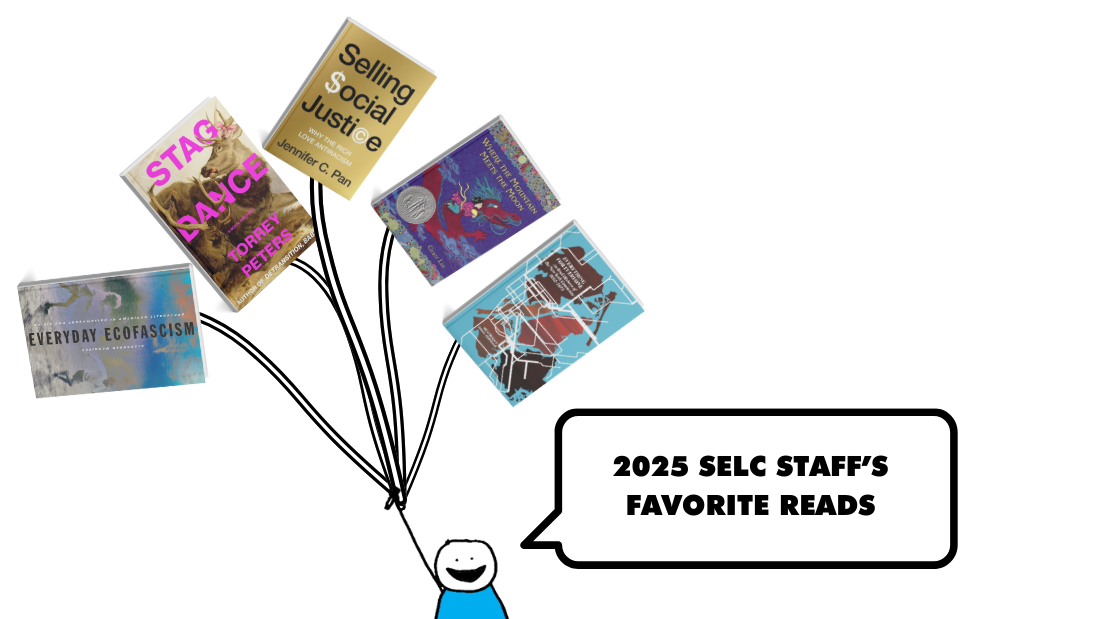
A favorite grounding practice at the Law Center is reading! Below is a list of a few of our favorite books from last year. These writings inspired us, made us cry, sparked our imaginations, and so much more!
Our Favorite Fiction Books:
The Deluge, by Stephen Markley (Recommended by Nicole)
I finished this 900 page tome while lying in a camper van in a gorgeous, secluded spot in the Canadian Rockies, surrounded by receding glaciers. My 6 month old daughter was napping on the bed next to me, and upon closing the book I proceeded to bawl my eyes out in a body-wracking 30-minute cry. This powerful, expansive, nuanced and insightful read into the climate movement starts in the near past, covering recent historic events, and extends into the following few decades. The book, published in January 2023, was wildly prescient, predicting major climate and political events of the last two years that would have been truly unthinkable previously (not giving any spoilers here, but I’m not talking about the return of the Trump administration, which many movement organizers foresaw). A multi-character epic showing the long journey of political formation of its characters and exploring the many roles to be played in response to the climate crisis - from denial to resistance, cooptation to sabotage - this book manages to be hopeful and devastating at the same time. A true punch in the gut, but one I could not recommend more.
Everything for Everyone: An Oral History of the New York Commune, 2052–2072 by M.E. O’Brien and Eman Abdelhadi (Recommended by Mohini)
I finished this book almost a year ago, and I haven’t stopped thinking about it since. I am captivated by the political vision laid out in this work of speculative fiction, telling the story of a global uprising that begins with the liberation of Palestine. Communes—neighborhood communities that ensure that everybody’s needs are getting met—reconstitute New York City, and the book is told through a series of twelve interviews set in New York between the now-elderly authors and individuals who played a role in the uprisings. People have loads of trauma to work through by the 2050s, so the story goes, but post-capitalist forms of locally-rooted but regionally-coordinated governance are slowly healing people and planet. Democracy is participatory, and ecosystems are being healed by restoring Indigenous lifeways. Most of the planet is free from nation-states, property, and even money. I first read this book in a reading group facilitated by our friends at Movement Generation, and I found it so compelling that I led a reading group for it at the Law Center, which initiated a yearlong learning series on the theme, ‘Beyond the Nation State.’
Spent: A Comic Novel by Alison Bechdel (Recommended by Sue)
I spent my 30’s and 40’s with these characters and so reading this was just like visiting old friends! Gosh I love Bechdel’s humor, politics, wonderings and love of community. If you aren’t familiar with the Dykes to Watch Out For series, or Alison’s hit Broadway show or its inspiration, the autobiographical graphic novel Fun Home you might not get as much out of this novel, but I think you’d still marvel at the depth of her drawings and the range of her musings on life, love and everyday activism.
Stag Dance: A Novel & Stories by Torrey Peters (Recommended by Mwende)
I heard about this book while listening to The Sam Sanders Show, when the host had Peters on. “Stag Dance” is a novella accompanied by three short stories. Peters uses four different genres — horror, speculative fiction, teen romance, and Western — to explore all the weird, funny, and grotesque ways we’re all being gendered in the world. Of the four stories, I think the titular story and “The Chaser” still haunt me. If you saw a big burly lumberjack cutting down a tree, could you ever imagine that one of his deepest longings was to be sweetly caressed and fawned over? I’m embarrassed to admit, I had not considered how cis men might be performing their gender, the internal gymnastics they might be doing, and who that performance might be for until “Stag Dance”. Since reading this book, I’ve noticed in my own life when I am unconsciously playing with my gender, especially in different contexts.
Our Favorite Children's Books:
Together We Ride by Valerie Bolling (Recommended by Tia)
When I learned that all of my favorite children's books with Black characters (Julian is a Mermaid; A Snowy Day; Yo! Yes!; The Princess and The Pea) were actually written by white writers, I asked my librarian friend Patricia Morán for help. For reasons I won't get into here, I asked for fun books with Black characters made by Black writers/illustrators that weren't about history or diversity. Together We Ride was the first one we found at the library. It's a book about a little girl learning how to ride a bike with her dad and each time we read it, my almost 4 year old half-white, half-Pilipino daughter notices something cool and new. Here's Patricia's whole list!
Where the Mountain Meets the Moon by Grace Lin (Recommended by Mwende)
My sister-in-law passed on her family's beat up copy of the book when her kids aged out and said it’s a great book to read aloud with the whole family. Grace Lin is a LEGEND in my house. This book had us all rapt! We read it on long car rides; as an incentive to brush teeth and put on pajamas; and as a way to unwind after dinner. If you’re familiar with the One Thousand and One Nights aka Arabian Nights folk tales — which is essentially a thousand stories within one story — “Where the Mountain Meets the Moon” is similar, but with Chinese folk tales. A brave and plucky little girl named Minli decides to go on a quest to meet The Old Man in the Moon to change her family’s fortune, and along the way meets a dragon, magical creatures, and many interesting characters. This book reminds me of the enduring transportational power of oral storytelling.
Our Favorite Poetry Books:
Falling Back in Love with Being Human: Letters to Lost Souls by Kai Cheng Thom (Recommended by Tia)
I started following Kai Cheng Thom on social media for her nuanced philosophy against cancel culture. I came to understand her philosophy even more clearly by reading her collection of poems! From forgiving the monsters who have harmed me to acknowledging the monsters within me to warning me about the monsters out there I’ve never had to encounter before, each poem is like a small offering that has brought me back to being in love with being human.
Pro-tip: Listen to the audiobook! You can hear Kai Cheng Thom’s own voice reading her beautiful poems and letters (and spells!) with all her rage and love and sorrow and sultriness.
Our Favorite Nonfiction Books:
Validation: The New Psychology of Influence by Caroline Fleck (Recommended by Sue)
One blurb said this book will make you a “better parent, partner, colleague, and friend” and I think it has indeed done that for me. Many of the learnings from this book have stuck with me and have improved how I interact in my relationships. It has made me better at expressing compassion and understanding and softened my tendency to explain, fix or justify when people are sharing with me. I like this book enough that I’m going to read or listen to it again. Which is the highest praise when my to-read list is as long as it is!
Selling Social Justice: Why the Rich Love AntiRacism by Jennifer C Pan (Recommended by Dorian)
This is a great book towards building a multi-dimensional analysis as to why some of the strategies we use, namely DEI, are not always in the service of liberation. I place this book in the lineage of works like “Elite Capture,” offering a critique of identity politics and how they serve ruling class interests. A figure that stuck with me in this book was reading how the DEI industry, at the time of publishing, was worth somewhere between 3 to 8 billion dollars, which is 10 times the budget of the National Labor Relations Board. It might feel in poor taste to stand behind this book in the aftermath of so many DEI initiatives being gutted, but understanding the history that gave rise to DEI in its anti-labor orientation is so important to know. It was sinister to read, for example, how certain union busting firms also offer DEI services as part of their package of services, and points to how a strong labor union movement, which serves Black workers more than any other race, is often undermined by DEI initiatives. I don’t seek to discount DEI wholesale, but I think it’s important to know how diversity initiatives do not upend oppressors, and often instead seek to create a diverse pool of oppressors. The author at the end aims the book towards universalist policies, such as the New Deal, that actually end up making conditions better for all people. Around the same time I read this book, I read a piece that talked about how closing the racial wealth gap among Black Americans for example, would mean just creating more Black millionaires. By contrast, universalist policies concern themselves with advocating for the development of a working class that can afford to live a dignified life. As I mentioned, this book should not be your entire basis for an analysis. It works best in conjunction with other books that talk about racial capitalism, and books that use non-state strategies as well.
Love in a F*CKED UP WORLD, How to Build Relationships, Hook Up, and Raise Hell Together by Dean Spade (Recommended by Tia)
In the intro of this book, Dean Spade lists his intended audience. Some examples include, people who “believe in compassion, connection, and collective action in the abstract, but… are tired of how annoying people are;” people who are “weary of constant conflict in activist groups;” people who are “trying to be perfect and feel deflated or defensive when you get critical feedback;” and people who can no longer rely on their friend circle because friends are “taking sides in breakups and dividing the group.” Check. Check. Check. And check.
This book has truly re-wired my brain to be more compassionate toward myself, my husband, my friends and family, my colleagues, and most importantly, toward people I wish I treated differently during conflicts that ended up breaking up our relationships. Love in a F*cked Up World calls on us to align our actions with our values, especially in intimate relationships where the romance myth and our capitalist culture of disposability have hammered scripts in us that often influence us to act otherwise. And to help us do this super difficult task, Dean Spade offers a bunch of tools, insights, anecdotes, and summaries of other less politicized self-help books.
I’ve already used tools from the book such as the “What Else is True?” worksheet. My favorite part about this worksheet is that it starts off with allowing you to validate the very strong feelings/beliefs at the moment e.g., “I hate this guy so much. He’s an entitled and avoidant holier-than-thou know-it-all and how dare he judge me during this very hard time in my life without knowing the whole story.” But instead of letting those strong feelings spiral inside you, the worksheet prompts you to brainstorm “what else is true?” and “what else might be true?” e.g., “maybe we’ll resolve this conflict in the future;” “maybe he’s going through his own crisis right now;” “I’m looking forward to getting dinner with my friends tonight;” “I can take a walk in 30 minutes;” “I’m excited to finish knitting this sock;” “I’m tired. I didn’t get enough sleep last night;” “maybe he’s tired too;” etc. You don't need to read the whole book to use the worksheet! Check it out here!
Read the book or listen to the podcast of the same title!
Everyday Ecofascism: Crisis and Consumption in American Literature by Alexander Menrisky (Recommended by Dorian)
I was reluctant to read any literature related to ecofascism at the risk that it would feel incomplete and myopic as most things do when filtered through grief. My hometown of El Paso is one of the prime examples of ecofascist violence, given that the mass shooter who killed 23, and injured 22, made reference to such themes in his manifesto. But this book is honest, and traces ecofascist discourse to sources way before our current present. I’ve been doing a lot of leisurely research around the origins of the counterculture movement, and it was nice to see the author cite so many other authors I’ve engaged with to draw the point that ecofascism is not exclusive to the right. In fact, he sees ecofascism as more of a genre to point out that it does not follow a strict recipe, but does follow a certain set of recognizable patterns of style and form that are attractive to people on both ends of the spectrum. I especially appreciated the author showing how movements that inform so much of my ecosystem - such as organic food, bioregionalism, commune living, and psychedelics - prefigure (a term he uses) the potential for expressions of ecofascism. I’ve grown sour of hippies throughout the years, but share so many aesthetic sensibilities with them. This book is a great way to help me contemplate in what ways we reify and enable an environment that is fertile for ecofascism as a sensible solution for our shared problems. For example, the author cites how both the German youth that would give the rise to the Nazis and the counterculture movement moved towards Romanticism, Eastern philosophies, and mysticism as a remedy for the alienation they were contending with. I think more than ever, we need to be brave enough to be introspective, and take responsibility, however limited, for the conditions that we are currently having to endure.
Burnout: The Emotional Experience of Political Defeat, Hannah Proctor (Recommended by Nicole)
This is a heady and academic read, but I couldn’t put it down. Examining the collective emotional experiences of left social movements, from exiled Paris Communards in the South Pacific to Bolsheviks in post-Revolutionary Russia to community mental health workers and activists in the radical anti-psychiatry movement of the 1960s, Proctor explores eight emotional states of political defeat: melancholia, nostalgia, depression, burnout, exhaustion, bitterness, trauma and mourning. Through literary analysis, film critique, and deep reads of diaries and memoirs of revolutionaries, Proctor surfaces the complex reality that revolutionaries both bring their wounds to their political work, and are wounded through the intensity of their political work. Healing is hard, and cannot wait on the revolution to happen. Yet healing within a broken and wounding system is inaccessible to most. Proctor draws on generations of radical actors to illuminate the painful contradictions of revolutionary struggle - the hope and depression, the motivation and burnout, the resilience and exhaustion. I saw myself over and over in these stories, and while the contradictions were not neatly resolved, I felt less alone.